Kamis, 03 Mei 2018

What is your spirit animal and what is it trying to tell you

What is your spirit animal and what is it trying to tell you

Image source: https://whatismyspiritanimal.com/wp-content/uploads/2015/09/Bear-Spirit-Animal-Totem-Power-Animal-Symbolism-Meaning-1200x1200-1024x1024.jpg

Spirit or totem animals are our connection to the earth and the animal/spirit world and offer guidance about where we are in our lives and where we need to expand and grow. We can have more than one spirit animal at a time and they can change during our lifespan. If you have a special connection or affinity with a particular kind of animal, this can often be your spirit animal, or if you begin to notice or see a particular kind of animal in your day-to-day life, pay attention to this as well. For example, you may begin to see several pictures of a particular animal all-of-a-sudden, see it in images or on television, or in real life.

I personally had the experience of seeing two spirit animals in the same short period of time when I was first learning about what my spirit animal was. My questioning nature at the time wanted a clear message and I was uncertain if my spirit animal was a dragonfly or a hedgehog since I was seeing them both all over. So, one night while lying outside in a hammock, I asked for guidance about which animal it was, and if it was in fact, a hedgehog or a dragonfly. Amazingly, not a minute later, a large hedgehog crossed my path but two feet away from me and just stopped and looked at me! Never in my life had I ever seen a hedgehog for real so it was quite something to see. Of course, after this, I knew this was my spirit animal needless to say. I laughed out loud thinking, Wow, if thats not a clear sign I dont know what is.'

Although your spirit animal may not come to you so dramatically, it will come if you ask for it. Just pay attention to your surroundings and be open to what the animal may be. Never in a million years would I have thought of a hedgehog for my spirit animalbut there it was in real life practically dancing in front of me. I new I had to pay attention and that the universe was trying to guide me. So I listened.

The symbol of the hedgehog was signaling me to open myself up to receive and to trust that what I was trying to manifest was coming. To continue moving forward and not shy away from my dreams and what I had to say. Strangely, or not so strangely, this was exactly what I needed to hear at that moment. And not just a few days ago, guess who reappeared again right in front of me? Yes, another big hedgehog just two feet away from me again out in nature. It seems I was needing another reminder to have faith and hold strong to my path and so I laughed again out loud in amazement and gratitude for this little creature who was trying to guide me. Thank you little hedgehog.

So what do you do once you know your spirit animal ?

After you have identified your particular spirit animal or animals, think about what the animal represents for you first. Ask yourself some questions:

What are the qualities of the animal?

Are they fast or slow? Big or small?

Do they have any particular physical characteristics?

Can they fly?

Are they water or land animals?

Do they represent something in your culture or country?

When you think of this animal, what characteristics do you think of?

Afterwards, you can also look up the symbolism of the animal for further information. Notice what resonates with you. Our spirit animals offer a lot of wisdom and guidance about how we need to move forward in our lives and some of our characteristics we may need to pay attention to. If youre open, they are there to teach and support you and even make you smile like my little hedgehog. They are a reminder that we are all connected to nature and that guidance and support is all around you if you pay attention.

You can also reinforce the presence of your spirit animal, by having reminders of it in your life. I recommend if you have a meditation or spiritual altar in your home, you put a small figurine or picture of this animal on it to acknowledge and honor its presence in your life. Give gratitude for the animal showing up and ask it to offer you further guidance. Let it be your guide, friend and support.

Take a moment now to think about any animals that you might feel connected to and ask yourself what its meaning could be for you. Feel free to let me know what your spirit animal is and what it's trying to communicate to you. Happy searching!

What Is Normal Puppy Behavior

What Is Normal Puppy Behavior

Image source: http://blog.adoptandshop.org/wp-content/uploads/2014/03/normal-dog-behavior.jpg

It's not easy to tell what is normal puppy behavior when the symptoms of bad behavior are similar. Puppies love to chew things, attack objects, and play with anything and everything that crosses their path.

This is all normal puppy behavior. Chewing helps to strengthen and clean their gums and teeth. Chasing objects is a natural preying instinct. It teaches them basic survival skills they once needed when their ancestors were wild creatures living off the land. Playing with objects is part of that learning.

Even puppies can get bored if they don't occupy their time in some entertaining way. In fact, this energy and level of curiosity causes puppies to be easily distracted and exhibit a short attention span.

When these and other behaviors become exaggerated, they are abnormal behaviors that need to be addressed early. Otherwise, you could end up with a problem dog on your hands.

Let's compare these normal behaviors with similar abnormal ones.

Easily Distracted

While a puppy will quickly leave one interest and move on to another, it is abnormal behavior when the puppy cannot stay focused for any length of time at all. If the puppy is to learn, it must be able to stay focused long enough to grasp the lessons. Puppies should be able to concentrate for at least five minutes or more. Those that can't will be difficult to train.

Switching from one play activity or object to another is normal puppy behavior. When the behavior becomes exaggerated, the puppy likely is hyperactive. You are likely to need considerable patience to teach a hyperactive puppy.

Chewing and Biting

Puppies normally chew items such as clothes, books, furniture, tassels on rugs and other fascinating objects. They like to mouth the hands of their owners and nip at people's feet. When puppies resort to snapping or attempting to bite people and other pets, or attack in a non-playful or threatening way, they are demonstrating abnormal behavior.

It's important to teach your puppy from the start what is objectionable and what is acceptable behavior. Puppies will not outgrow their bad behavior. It's up to you to teach them.

Chewing and biting is one of the biggest concerns for owners because puppies tend to get into things you cherish, like your favourite pair of shoes or the edge of a sweater protruding from the laundry basket.

Discourage Bad Puppy Behavior

When your puppy attacks in an aggressive, rather than a playful, manner it's important to correct him immediately. Stop him firmly and tell him "No". If he persists, give him some quiet time away from people and other pets but make sure he can still see what's going on. Isolating him behind a closed door will cause him anxiety and lead to problems later.

After about 30 minutes, let him out again and go through the steps again, telling him "No" and removing him from the action until he begins to understand. Praise him when he cooperates so he knows he's doing the right thing.

Make sure he gets a lot of exercise, as lack of exercise will contribute to boredom and bad puppy behavior.

If he continues to exhibit aggressive or destructive behavior, talk to your vet for advice. Ask if there might be a medical or physical reason for his behavior.

Encourage Normal Puppy Behavior

Because of their curious nature, puppies are always looking for new objects to play with, new items to chew. You can deter this wandering spirit by experimenting with different kinds of toys. See which ones he likes the best and look for more that are similar.

Rather than giving your puppy all the toys at once, rotate them. Puppies have short memories. When you return a toy after a few days, they will think it is something new and take to it readily. Allow your puppy to have four or five toys at a time and then replace them with a different set after a few days.

You'll soon see how this technique can distract your puppy from going after your important items.

Toys you can fill with puppy biscuits or peanut butter make excellent toys for the treasure seeker. The work involved in getting those entrapped goodies piques your puppy's sense of adventure and in a way, appeases his prey instincts.

Remember that all puppies are inquisitive and have an insatiable appetite for adventure, to examine every aspect of their environment and test their skills. Recognize when their actions are excessive and take appropriate action. By taking steps right away, you can encourage normal puppy behavior and look forward to enjoying a well-behaved adult dog.

Rabu, 02 Mei 2018

What Is It Like To Become An Exotic Pet Vet

What Is It Like To Become An Exotic Pet Vet

Image source: http://cdn.cnn.com/cnnnext/dam/assets/120404102258-exotic-pets-teymour-the-lion-horizontal-large-gallery.jpg

If you are a practicing local veterinarian, you might want to consider taking in exotic pets as patients too. Regular pets like dogs and cats maybe a common thing for you, but are you ready to take on the challenge of being an exotic pet veterinarian?

Since you are in this field for quite sometime you might think of becoming one. Being an exotic pet veterinarian has a lot of advantages. And here are just some of them.

1. You will have a broader range of clients. Imagine more people consulting you for all their pets, no matter what kind it is. That also means you will be able to earn more by being able to expand your clinic or office.

2. You will become more famous. There are just a few exotic pet veterinarians in your area, for sure. A regular veterinarian may be one too many, but an exotic veterinarian isn't. You may even have customers coming from other states, just to consult you regarding their pets.

3. You will widen your knowledge about animals. Being confined to dogs, cats, and other regular pets could be less challenging after being in the field for too long. Maybe it's time to take your expertise to another level and take on skunks, turtles, and snakes as patients.

4. You will be able to help the environment. Being a veterinarian of exotic pets would enable you to help injured and very sick animals out of danger. You can lengthen their lives and add to the preservation of their species in the process.

5. You will be able to inform other people. As you attend to sick exotic pets, you can enlighten its owners as to the proper care these types of animals need. And you will also be able to give them tips to prevent the same illness from happening again.

6. You can use your knowledge and expertise in reaching out to more people. Once you have became an exotic pet veterinarian and have done well in it, you will be able to use all the things you have learned in making informed decisions people wanting to get exotic pets. You can join an advocate protecting exotic animals or other similar organizations according to your personal beliefs and principles.

Being an exotic pet veterinarian could mean lots of things to learn and lots of information to digest, even if you are a practicing veterinarian already. You might even go back to school again for that purpose alone. But think of the things it can give you. Being an exotic pet vet can become really fulfilling so just go for it.

What is Diesel Exhaust Fluid Who Needs It

What is Diesel Exhaust Fluid Who Needs It

Image source: http://platinumfueltech.com/assets/EcoDef-Collage.jpg

What is Diesel Exhaust Fluid? Who Needs It?

Heres a little quiz:

When have emissions rules ever produced better-running trucks?

If you answered, How about the 2008 Tier 2 or 2010 Clean Air Act standards, you can stop reading. You probably already know everything in this post.

For the rest of you, the answer is, When it became clear that diesel exhaust fluid, or DEF, was a key part of the solution to the emissions problem.

Everyone whos ever driven behind an older bus or semi belching smoke and diesel exhaust knows the problem: Diesel engines are dirty and smelly.

Thats the price weve paid for power and torque that gasoline engines cant equal.

DEF brings that price way down.

Heres why.

The Diesel Penalty

Combustion occurs in a gasoline engines cylinders when a spark ignites a mixture of fuel and air.

A diesel doesnt use a spark. Instead, it greatly compresses a leaner fuel-air mix.

Its the high degree of compression that causes the fuel to ignite.

Unfortunately, the compression-ignition process also produces emissions that are higher in dangerous nitrogen oxides (NO) and particulates.

And the Solution

To meet air quality standards calling for lower NO levels, manufacturers adopted an approach called selective catalytic reduction, or SCR.

With SCR, a small amount of fluid is sprayed into the exhaust stream. The chemical reaction that occurs converts NO emissions into harmless nitrogen and water.

In fact, what comes out of the tailpipe of a diesel using SCR may well be cleaner than what goes into the engine in the first place.

That was helpful in 2010. Its essential in 2017 when regulations call for a 90% reduction in allowable nitrogen oxides from exhaust.

The magic responsible for the reduction is the DEF: a 32.5% solution of ammonia in ionized water. And its a powerful (and somewhat misunderstood) solution to a serious problem.

What You Need to Know

DEF lives in a reservoir in your vehicle, which usually holds about five gallons.

In GMs heavy duty trucks, customers get about 1,000 miles per gallon of DEF. Heavy hauling or towing can increase the rate of DEF consumption just as it does with fuel.

In consumer vehicles, DEF can be consumed at a rate of roughly 2.5 gallons per 800 miles of driving.

The DEF tank must be kept at least partially full at all times. Many diesels wont run at more than 4-5 MPH if the tank runs dry. Others wont run at all.

Fortunately, it shouldnt be a problem, since most manufacturers provide a gauge, digital readout or low fluid level warning on the IP.

And keeping the tank topped off is easy and relatively inexpensive.

Manufacturers have built DEF service into their scheduled maintenance specs. So the fluid can be topped off when owners bring their vehicles in for scheduled service.

And DIY-ers can easily maintain DEF levels themselves, much as they would washer fluid. The fluid is readily available at dealerships, trucks stops and auto parts stores, usually at about $5/gallon.

Truck stops often have DEF pumps on their fuel islands.

The Upside

Maybe the biggest misperception about DEF is that its a drag on performance.

In fact, the opposite is the case. Manufacturers have tuned their diesels such that DEF actually optimizes combustion.

That means better fuel efficiency, more power, less engine wear and high reliability.

And there are other myths:

DEF evaporates quickly. (In fact, it evaporates very slowly.)

Its a drag on mileage. (In fact, it offers better mileage than most other emissions reductions systems. Manufacturers estimate a mileage bump of as much as 5%.)

Its toxic. (In fact, its less toxic than many of the other fluids used in a vehicle. And its been used for years in commercial trucking and the ag industry.)

Some Caveats

While DEF is good for newer engines with DEF systems, its useless in older diesels that lack such systems.

And DEF should never be added directly to fuel. Its corrosive and can reduce your fuel system to worthless scrap.

Thats why some manufacturers provide under-the-hood access to the system. Others provide a separate filler neck next to the fuel cap.

Either way, if you suspect your fuel has been contaminated with DEF, dont even turn the ignition to accessories, which can activate the fuel system.

Instead, have the vehicle towed, without starting, to a repair shop. Have them flush the fuel tank, then get back to enjoying the diesel power, torque, and reliability which DEF enables.

What Is A Mockingbird

What Is A Mockingbird

Image source: http://upload.wikimedia.org/wikipedia/commons/c/cf/Northern_Mocking_bird_-_Mimus_polyglottos.JPG

The mockingbird is the state bird of Texas. If you ask any random Texan about the bird, you will discover that the mockingbird has the most stunning of all songs among the different species of birds in Northern America. That is conceivably the reason behind the mockingbird to have been adopted as the state bird of Texas in 1927.

The song of the mockingbird is actually a combination of the calls of various other birds. Each form of simulation is repetitive in nature. It is rather regular for an individual bird to have as many as 25-35 songs in it repertory.

It is a common urban bird that is 10 inches in length and about 13/4 ounces in weight. The wing span of the bird is about 14 inches long. The mocking bird is an omnivore and a diurnal. Its sexual maturity takes an entire year. Spring and early summer are the mating seasons and the mockingbirds usually nest twice a year however sometimes three or even four times when the conditions are favorable. Their eggs hatch in 12-13 days and the young ones then fledge off in 11-13 days after that. The eggs of the birds are blue-green in nature with unusual brown markings on them. The birds make their nests low towards the ground, which is like an open cup of grass and twigs with rootlets carelessly arranged in a dense form. The mockingbirds do not migrate once they have a permanent resident.

Mockingbirds thrive in open grassy areas for their feeding and diet. They hide their nests behind thick thorny shrubs. Gardens are among one of the birds favorite dwelling places particularly if any winter berries are available. The mockingbird's basic diet is insects (beetles, ants, grasshoppers and spiders), berries and seeds.

A few of the extraordinary facts about the bird is that only the unmated males sing at night. Mockingbirds also often form long-term pair bonds. Scientists have also found that the female mockingbirds are attracted to males that can make the most different of all sounds.

The mockingbird is also known as a vicious guardian of its nest and surroundings. It is sometimes seen swooping down on a dog, cat or predator that may be advancing too close to the birds protected territory.

The mockingbird was adopted buy the Forty-seventh General Assembly of Arkansas on March 5th, 1927 as the State bird of Arkansas, Florida, Mississippi, Tennessee and Texas and one of the few birds found in every kind of habitat, from desert to city.

The mockingbird is one of nature's most marvelous wonders. Other than its physical beauty, the bird's ability to imitate sounds and make a combination out of them is remarkably pleasing to the ears. Perhaps, due to mocking birds' capability to imitate sounds it causes a link to mockery and conceivably it gets its name as the mockingbird through that context. Indeed, it is one of the most spectacular birds of nature.

Selasa, 01 Mei 2018

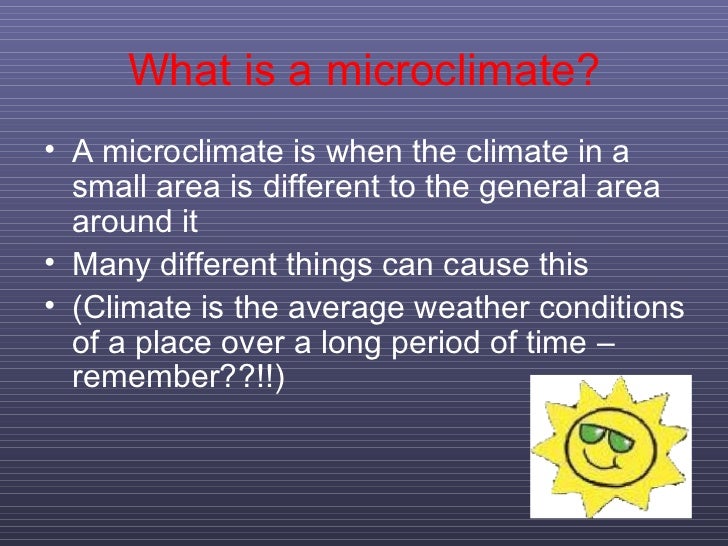
What is a Climatologist

What is a Climatologist

Image source: https://image.slidesharecdn.com/microclimate-factors-26723/95/microclimate-factors-2-728.jpg?cb=1180803137

A climatologist is someone who studies climates. Although often confused with meteorology, climatology is quite a different profession. Think of it this way. A meteorologist studies the climate just in the short term.

The career outlook for a Climatologist is favorable. They make on average $55-$95 thousand a year.

He or she predicts what the weather is going to do, including the winds, and the amount of precipitation we are going to have.

By contrast, a climatologist studies trending climate over the long term. For example, the climate you live in depends on where you live geographically. If you live in the South of the United States, for example, your weather is generally going to be much warmer overall that it will be if you live in the Midwest or in the northeastern region of the United States. This "climate" is what a climatologist studies, not short-term weather patterns predicting what's going to happen today, tomorrow or next week in the weather so that you can wear a raincoat out the next time you go to work or school, for example.

What climate determines

The climate you live in determines several things about the area you live in. The type of plants that grow there, are one example of what climate affects. As a climatologist, you study the climate in a particular area and then try to forecast what's going to happen in the long term. What will happen with climate over the long term affects everything, from food production, to survival of endangered species, to energy usage, even health, life expectancy, or the very survival of the human race itself.

Becoming a climatologist

If you become a climatologist, you'll need to study physical and biological sciences and get a degree in atmospheric science or something similar. In general, you'll start working with other climatologists who are more experienced than you are. As you advance in your profession, you can specialize in what you feel most comfortable with, such as in the lab doing data analysis or in the field collecting research.

What does being a climatologist have to do with being "green"?

As a climatologist, you not only study the long-term trends in climate within a given area, but you also try to forecast what's going to happen over the long-term with the climate in a given area based upon several characteristics. Among the things you study, for example, are the effects pollution has on climate both now and in the future. For example, you study what's called "atmospheric aerosol content," which are microscopic particles NOT made of gas but that nonetheless affect climate like greenhouse gases do. These types of particles can be both natural and man-made. Some examples include mineral dust, ammonium sulfate, pollen, carbon or soot emissions, and so on.

By studying these things, you as a climatologist can help predict how our human behavior is affecting the earth either negatively or positively in regard to climate. You can also work with other scientists to make recommendations as to changes humans can make so that we positively affect our climate and therefore our very survival.

For example, climatologists were among the instrumental scientists who discovered global warming and told us what we can do about it so as to slow it down and therefore protect the health of the planet, other animals' survival, and our own survival, too.

In other words, you as a climatologist can absolutely give humans the knowledge we need to change how we behave so that we protect the planet, ourselves, and the other species that live here.

What Does It Really Cost To Raise That Pet

What Does It Really Cost To Raise That Pet

Image source: http://big.assets.huffingtonpost.com/55d3657e170000b700567d18.jpeg

If your household is one of the many, many homes in the United States that acquired a pet this Christmas you received a gift that you and your family will enjoy for years. In fact, it probably already feels like the pet is a part of the family. However, like any other member of the family that new dog or cat will need to be taken care of. In this article we will help you budget for the new member of your family.

If you welcomed a puppy and kitten into your household this Christmas they will already have grown noticeably. In fact, they have probably doubled in size already and you may also notice that they have pretty ferocious appetites for their small size. The costs of feeding your pet and giving it the care it deserves can add up pretty quickly so the sooner you start factoring these costs into your monthly budget the better.

If the new addition to your family is a small animal such as a rabbit or a hamster, then it certainly won't break the bank. However, dogs, and even cats, can be notoriously expensive.

Dogs are hugely popular at Christmas and now that you are into the New Year the true cost of keeping one is probably becoming apparent. It is probably still a puppy now, but towards the end of this year it will be fully grown and will be much harder to control. For this reason you should start saving towards the cost of dog training. This can be quite expensive but it is well worth it for the peace of mind it gives, especially if it is a large dog. You can rest assured that it will do what its told, and it will be much less likely to run away or cause damage or injury.

Prices for dog training vary, but as a rough guide four weeks of training will cost in the region of $2,000. This would usually consist of two hours training a day, five days a week for four weeks. This should be enough to have an average dog very well trained. If you feel this is above your budget you should at the very least buy a good dog-training book. A good dog-training book shouldn't cost you much more than $20 or $30.

Training is a once-off cost. More important is preparing for the monthly costs of keeping an animal. It is estimated that an average dog will cost somewhere in the region of $12,000 dollars to keep over a 12-year life to feed. This does not take into account vet bills, medicine, toys, and other equipment such as kennels. In reality, you should be setting aside about $2,000 every year to keep a dog healthy and happy. Cats will be a little cheaper, but not significantly, at about $1,400 per year.

These estimates cover basic costs. However, owning a pet can get just about as expensive as you want to make it. If you want to dress your dog up in designer outfits then prepare to pay the price. Also, if you travel you may need to pay for a pet passport, micro-chipping, quarantine and other costs.

Another thing you may want to consider is pet insurance. This needn't be expensive and will cover costs if your pet becomes ill or is stolen. If you have had a pet for a while you will be well aware that those vet bills soon add up so it could save you money in the long run.

Pet insurance policies can vary significantly both in terms of cost and quality, but for the most part you get what you pay for. Be sure to read the small print so you know exactly what you are or are not getting. A basic policy that covers illness should be quite cheap, but you may be offered all manner of optional extras. Some policies will cover the costs of advertising and a reward if a pet is lost or stolen. Others, will even cover the cost of counseling for family members if the pet dies or is lost.

So, if you got a dog for Christmas you should be at least setting aside about $200 dollars a month if you really want to look after it well. This is a significant extra cost on top of your normal monthly budget. However, when you think of the fun and happiness the new member of the family will bring to your home it is money well spent.

2012 Earthquake Flood Predictions Psychic Reading

Image source: https://tanahoy.files.wordpress.com/2011/03/disaster2001-heavymetal-5.gif A little famous reality is that this angle has been ...